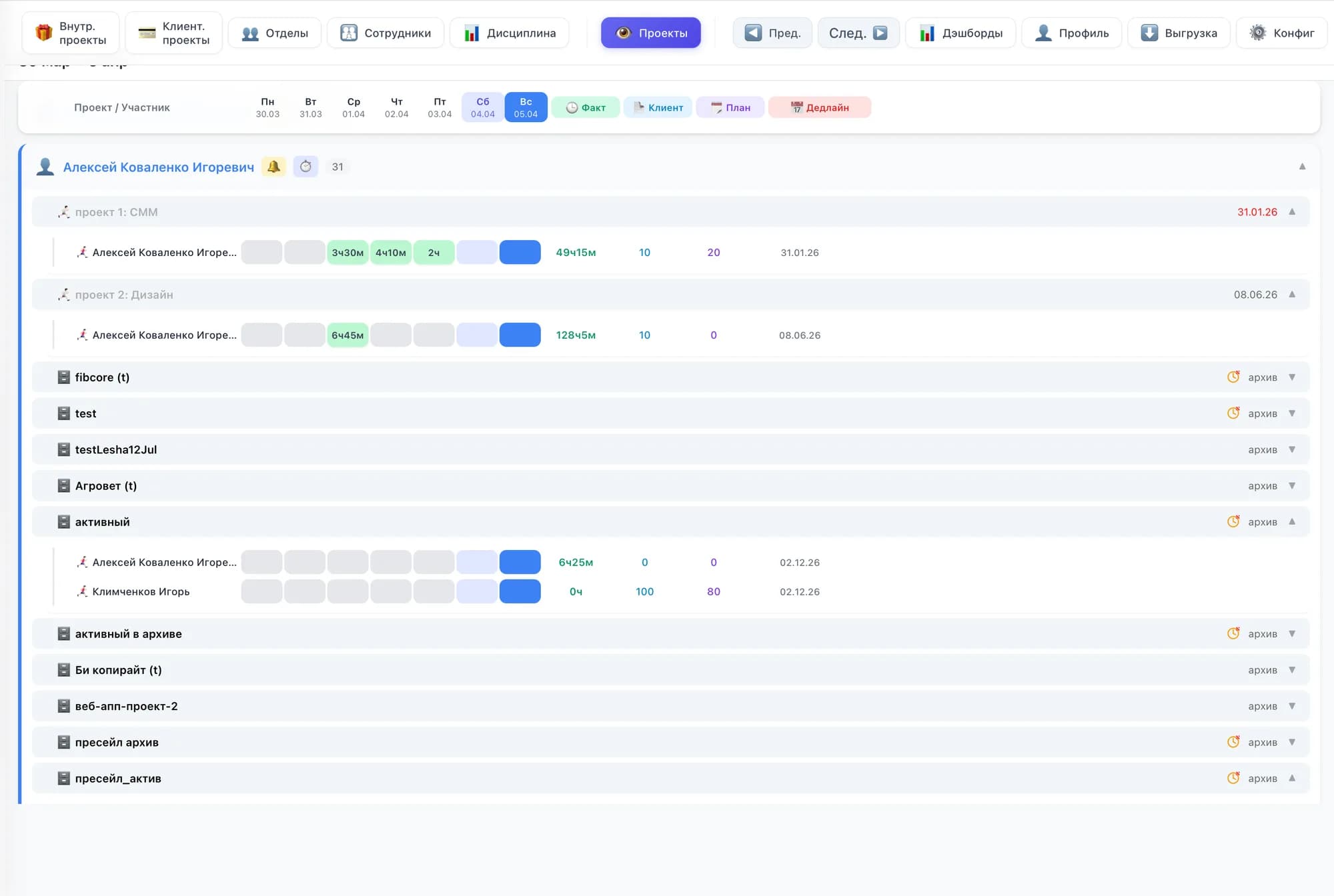
SETTERS Resources Manager — Resource Management & Time Tracking System
2026Full Cycleresource-management
Role
Full cycle: from idea and architecture to development and deployment.
Tech
| Layer | Stack |
|---|---|
| Web app | Next.js 16, React 19, TypeScript |
| Telegram Mini App | Vanilla JS + Telegram WebApp SDK |
| Database | Supabase (PostgreSQL) |
| Authentication | Telegram ID + encrypted sessions |
| Deploy | Docker, GitHub Actions, Nginx |
| Integrations | Bitrix24, Telegram Bot API |
Key features
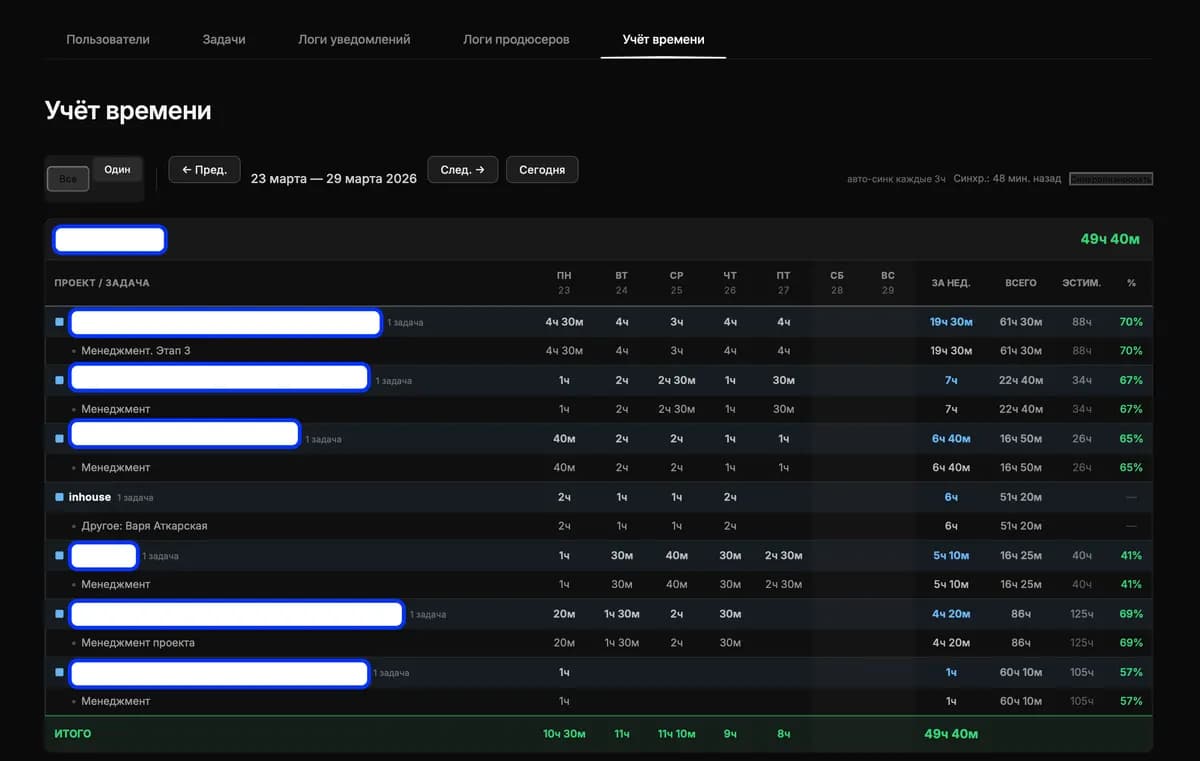
- 01Weekly team workload overview by department with drill-down to specific days and projects
- 02Project management: statuses, deadlines, team, contract and internal hours, Bitrix24 sync
- 03Discipline analysis — who isn't logging hours, who has gaps, fill rate by department
- 04Production calendar with flexible holiday and working day configuration
- 05Internal projects for tracking non-billable workload
01
Problem
Agencies and service companies drown in resource planning chaos. Who's available, who's overloaded, how many hours were sold to a client vs. how many were actually worked — the answers are scattered across spreadsheets, chats, and managers' heads. People forget to track time, managers learn about problems after the fact, and month-end close turns into a detective investigation.
02
Audience
| Role | Scenario |
|---|---|
| Account manager / project manager | Sees team workload for the week, distributes people across projects, monitors contract hours burn |
| Department head | Tracks fill rate and discipline across the entire department, catches overload before it becomes a problem |
| Team member | Logs hours in 30 seconds in Telegram, without leaving the work chat; sees personal stats and history |
| HR / resource manager | Plans vacations, sees real people availability, understands team capacity |
| Admin / operations director | Configures deadlines, calendar, access rights; gets a holistic view across the company |
03
What's different
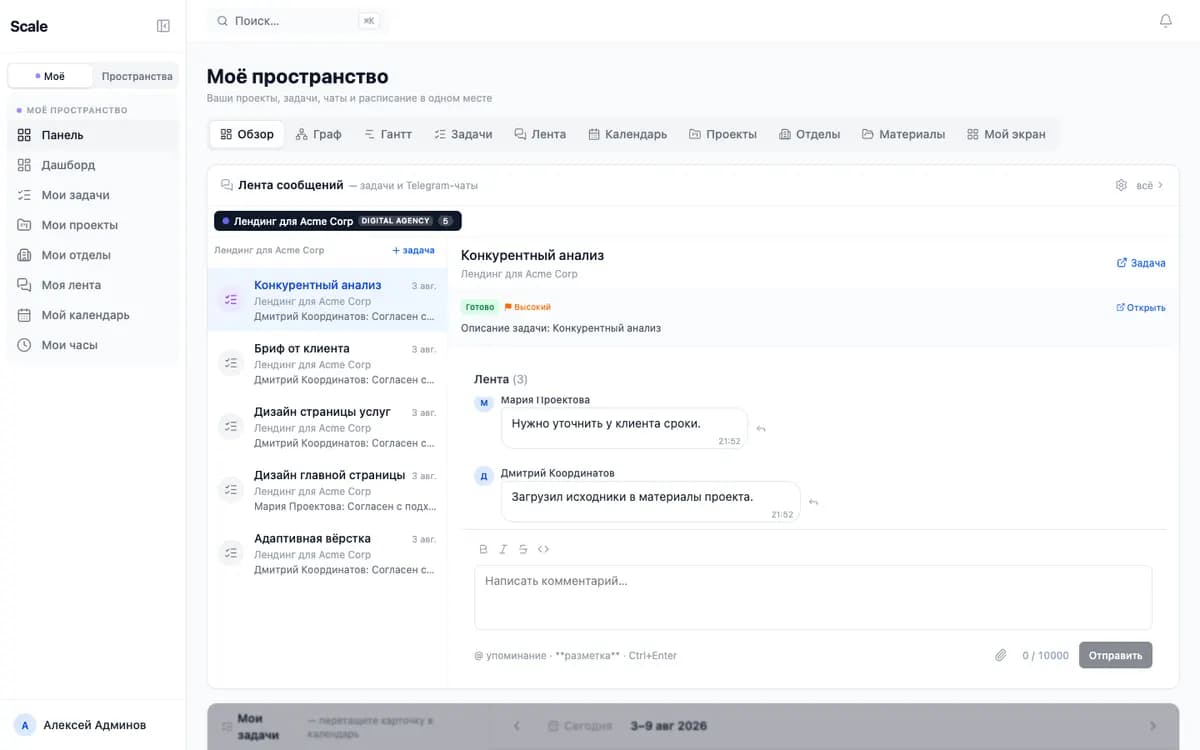
- Telegram-first approach. Employees don't open a separate service — tracking is built into where they already spend their workday. This solves the core pain: people actually log their hours.
- Two roles — two interfaces. Instead of a universal UI that's convenient for no one — a minimal form for the team member and a full panel for the manager.
- Auto-lock periods. The deadline is configurable; after it, the month's data is frozen. No endless retroactive edits.
- Built for the agency model. Contract vs. internal hours, presales, subscriptions, multi-project — this isn't a task tracker adaptation, it's a tool built for service business realities.
04
Mini App & Chat
05
Admin Panel
06
Customization
- 01Month-close deadline — configurable via the admin UI
- 02Production calendar — arbitrary working/non-working day ranges, timezone
- 03Department and project structure — unlimited nesting, flexible roles (lead, manager, member)
- 04Project types — one-off, subscription, internal; custom lifecycle statuses
- 05Access control — full access for admins, restricted for others
- 06Branding — styles, fonts, favicon, name via config and CSS
- 07Integrations — API endpoints are extensible, webhook architecture allows connecting new services
Other projects
Need something like this?
Tell me about the task — I'll suggest an approach, pick a stack and scope it out.